


Re-reading the legacy of Imam Haron
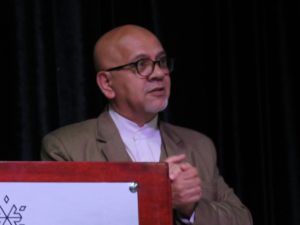
By Aslam Fataar
As we enter the 50th year since the tragic passing of Imam Abdullah Haron, the question arises
whether we dare read the Imam’s legacy differently and put such a reading to productive work in
our current times. The seed was planted during the 11th annual Imam Haron Memorial Lecture which
was delivered this year by his son, Muhammed, at the Zohra Noor Auditorium, Islamia College, on 26 September.
Professor Haron pointed to this by offering a nuanced and contemporaneous reading of his father’s
life. In the lecture Prof Haron combined personal insights with a portrayal of key formative events in
the Imam’s life.
Haron, the son, called for a broader and more incisive range of scholarly work that would bring his
father’s life into fuller, multi-dimensional view, which, I believe, would offer a robust ‘reading’ of
the meaning of such a life for complex contemporary times.
Imam Abdullah Haron was born in Claremont on 8 February 1924 and brutally killed by the apartheid
regime in prison on 27 September 1969. He was the Imam of the Al-Jaamiah Mosque in Stegman Rd,
Claremont from 1955 until his death.
The political and broader discursive parameters have changed fundamentally, and the Imam’s legacy
should be mined to allow us to work productively with a fuller more complex set of human dynamics
that attend to our lives in Cape Town and the world. The impending 50th anniversary
commemoration is an apt opportunity to begin this task.
Muhammed Haron correctly and courageously portrayed his father as a ‘man (sic) for all seasons’, a
person with a multi-dimensional personality, a photogenic family man, a great dresser, a brother and
father who was actively engaged in the lives of his siblings, who loved his dear wife, Galima (nee
Sadan), and played a formative role shaping the sensibilities of his three children, Fatiema,
Muhammed and Shamela, the latter who settled in the United Kingdom where she raised her own
family.
The Imam was an avid music lover. He had a piano in his house in Crawford and encouraged his
children to appreciate music. He was involved in active inter-faith work and encouraged the reading
of literature, religious and Islamic books, and the English translation of the Qur’an.
There are many photos of the imam surrounded by his younger congregants. Muhammed Haron
explained that his father loved children and young people. A powerful memory for Muhammed was
his father’s constant recitation of the Qur’an – in other words, of a person who was a hafith-al-
Qur’an ( one who memorised the entire Qur’an) – and had come to personify its ethical message.
The Imam’s life was thus accompanied by the Qur’an, and he was motivated in life by its exhortation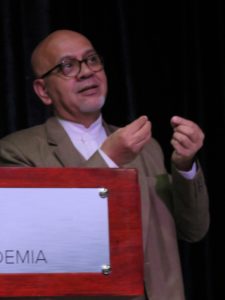
to fairness and justice. And so, as Muhammed Haron explained, he was always wont to give
testimony to the injustices, big and small, which he encountered. It was the injustices associated
with racism and apartheid that became the Imam’s imprimatur, the spiritual fuel that imbued his life
with the clarity of moral purpose
The Imam for all seasons was above all a witness bearer for justice, in the way exhorted by the
Qur’an which his life was immersed in. Bearing witness was what gave meaning to his life, and in
displaying his commitments, in an often questioning and conservative community, his example
shone like a very bright light.
He was a person ahead of his time, never fully supported by the broader Muslim community or its
organisations. This community was mired in living its own accommodations with the brutal
apartheid state, turning a blind eye to its repressive machinery, as it tried to maximise some
advantage in dire circumstances. Arguably, some prominent people in the Muslim community were
compliant supplicants of the apartheid state, collaborators seeking advantage.
Imam Haron’s legacy was picked up and celebrated prominently only later, by young educated
Muslim students and others, from the late 1970s. They appropriated his legacy as one of their key
mobilising platforms for their activism, in the process correctly emphasising his anti – apartheid
legacy and martyrdom. The other dimensions of his life, including art, reading, family, sport, interfaith advocate, retail
worker, and snappy dresser, in other words, the more mundane aspects, may have been
underplayed. Offering a reading of his legacy by emphasising these aspects would be a first step,
which together with his political commitments, would offer deeper understanding of Imam Haron’s
legacy.
Based on asserting his multi-dimensional legacy, l believe we ought to have important conversation
about how such a legacy could be put to work in current times. Imam Haron has much to offer us in
democratic times, of hopes dashed, a faltering and corrupt state, and multiple human rights
tragedies occurring daily.
Imam’s legacy would have much to say about how we as citizens of this country and the world ought
to go about establishing a caring, humane and inclusive society. But, the route towards such a
dispensation depends on us. Imam’s life provides many important clues but we have to step up to do
the intellectual work and activism to make his legacy come alive in novel, inclusive, open-minded
and exciting ways in our city, country and the world.
(Aslam Fataar is a Professor in the Department of Education Policy Studies at Stellenbosch
University).
Click here for the transcript of Prof Muhammed Haron’s lecture